Not too long ago I had an idea.
It was time to go to Buffalo.
No, I’d never been.
Because, you know…it’s
Buffalo.
But Buffalo has more than its share of architectural and historic landmarks—and Niagara Falls is nearby—so it was easy to put together a day or two of geeky touring. Food wise, people swear by the wings. My friends Martha and Bruce said that they were game for an adventure. And so off to Buffalo we went.
The first stop was Buffalo’s passport office. I wanted to see Niagara Falls from the Canadian side of the river and the days of crossing the border with just a drivers’ license are long gone. My passport expired in late August, so I needed to get a new one on an expedited basis.
Security was tight; there were three guards in the postage stamp sized lobby of the passport office. The guards gave me detailed instructions about which line to get in, which chair to sit in, and which window to approach. They probably think that if you’re too stupid to sit in the right place, you’re too stupid to get a passport.
Fortunately, I got in the right line, sat in the right row, and approached the right window. My papers were in order I was told to return in a few hours for my new passport.
Our next stop was the
Buffalo City Hall. There was a time when an impressive city hall was a point of pride for local governments. Philadelphia, San Francisco, and yes, Buffalo, have city halls that are tourist destinations…for architecture nerds at least.
Buffalo’s impressive 32-story Art Deco pile, designed by Buffalo architects, Dietel and Wade, was completed in 1931. The architects pulled out all the stops when it came to decorating the lobby.
We took the elevator tor the Observation Deck. The elevator, like the rest of the building, wasn’t air conditioned, and the two city employees sharing the car with us told us that the elevators got stuck between floors from time to time. It was about 90 degrees in the elevator. We hoped it wasn’t our lucky day.
The elevator stopped a couple of floors from the top of the building. We hoofed it up the final two floors. I love the fact that whoever made the sign wasn't exactly sure where we were going...and no one has bothered to make a nice new sign. As Bruce says, "OK is good enough!"
The views from open air observation deck were spectacular. The winds were fierce. I’m not good at heights; I wondered if anyone had been blown over the plexiglass railing, like
Auric Goldfinger being sucked out of his jet.
I could see the headline:
Geeky Tourist Dead in City Hall Mishap
High Winds, Lack of Coordination to Blame
Fortunately, we made it back to the ground floor safely.
We were a tad early for our next stop so we make a quickie visit to
St. Paul’s Cathedral, designed by
Richard Upjohn, the architect of New York City’s
Trinity Church. The brown sandstone church sits on a triangular site resulting from Buffalo’s radial street plan, inspired by L’Enfant’s plan for Washington DC. Episcopalians aren’t minimalists when it comes to interior decoration, so there was plenty to take in, including a Tiffany window.
The cathedral hadn’t yet adopted the State College Presbyterian Church men’s room doctrine of lift the handle for number one; depress the handle for number two. As they say, God moves in mysterious ways.
Our third stop on our architecture nerd themed weekend was an early skyscraper, the
Guaranty Building, right across the street from the cathedral. We had reserved spots on the 2:00pm tour through
Preservation Buffalo Niagara.
The Guaranty Building (sometimes referred to as the Prudential Building) was designed by
Louis Sullivan (the form follows function guy) and built in 1896. Along with its slightly older sibling, St. Louis’s
Wainwright Building, it’s pictured in many histories of American architecture. Like Buffalo itself, the building has had its share of good years and bad. The building is enjoying good times now and is immaculately maintained by its owner, a large law firm.
There were only five of us on the tour. There is a pleasant ground floor museum the size of a large Starbucks, with a video, text panels, archival photos, and even a model of the building. The exhibit goes into some detail on how the building's orange terracotta sheathing was made.
Our knowledgeable and friendly docent walked us through the exhibits, then through the lobby of the building, past the elevators, and out onto the sidewalk. And that was the tour. As Peggy Lee sang,
“Is that all there is?”
I suppose the law firm didn’t want us visiting the document shredding room or seeing the boardroom where partners light Cuban cigars with $100 bills. People are so touchy these days. Our guide made up for the brief tour by suggesting we see the downtown branch of M&T Bank to see its collection of “not always PC” vintage mechanical banks. It was just a block away from the passport office, so after picking up my new passport, we stopped in.
The Beaux Arts confection that used to be the Buffalo Savings Bank was built in 1901, when the stability of a financial institution was expressed in bricks and mortar.
The building, with a domed banking hall and a quarry’s worth of white marble, shouted that deposits were safe there. Interestingly enough, the bank became insolvent in 1991.
Our docent was right, the collection of mechanical banks wasn’t PC but was worth the visit.
When we’d finished at the bank, it was time to check in to the hotel. We bunked for the weekend at the
Hotel Henry Urban Resort Conference Center. Even after staying there, I still don’t grasp the concept of “Urban Resort”.
The building was built from 1872-1880 as the
Buffalo State Asylum for the Insane, and provided state of the art mental health treatment (such as it was) for up to 600 patients. It’s an enormous place, designed by
H.H. Richardson amid grounds laid out by landscape architect
Frederick Law Olmstead, the designer of New York's Central Park. The salubrious atmosphere created by top notch architectural and landscape design was supposed to turn lunatics, the deranged, and chronic masturbators into model citizens, or at least accomplished basket weavers.
As a hotel, it’s plenty handsome from the exterior if you like Richardsonian Romanesque architecture. Of course, you need to overlook the chain link fence that seems to be a semi-permanent fixture on the grounds, not to mention the dilapidated parts of the complex.
I’m not sure how well the place worked as an insane asylum (or “wellness center” as one of the front desk staff members called it) but as a hotel, it has some issues.
For starters, it’s difficult to find the entrance to the property. Signs, apparently, are for weenies.
After I found the entrance, at the back of the building, I had to ask the valet how to get to the front desk—it’s not obvious. He told me that it was up two flights of stairs. Considering the fact that the main floor has an 18’ ceiling, that’s a decent hike.
It was another hike down the grand staircase to my room. The hotel’s hallways doubled as its fancy farm to table dining area. Guests (trust me, no bellman was in sight) carry their bags right by diners chowing down on non-GMO free-range heirloom organic wings accompanied by vegetables that no one has ever heard of. Call me an old fuddy duddy, but I don’t particularly enjoy a floor show of people schlepping roller bags past my table when I’m eating dinner.
I opted for one of the less expensive rooms, overlooking a dumpster and an enormous HVAC unit.
Except for the view, my small room was nice enough. There were two beds, a tiny desk and a chair that no one was ever going to sit in. It was day two before I figured out how to work the window blinds, and operating the shower control required graduate level courses in fancy European plumbing fixtures. The bed was ok if lower to the ground than usual, but there was no clock, no drinking glasses, and the TV was small-ish. When I checked out I suggested to the clerk that they call the My Pillow Guy about getting some decent pillows.
Oh, and I never really figured out why this sign was on the door we used to take a short cut from the parking lot to our rooms. A nod to its days as a "wellness center", no doubt.
So, as hotels go, a solid “meh”.
I’m glad I stayed there, but if you want a hotel where they do everything right, you’re better off at a Courtyard by Marriott.
Friday evening we enjoyed tasty non-wingy Italian fare at
Trattoria Aroma. Anthony, our waiter, was the life of the party. Shortly before we left, I wanted to ask him about a place to go for breakfast. Who better to ask than a cute and seemingly hip server?
“Anthony, may I ask you a personal question?”
He responded with alacrity:
“I’m single and gay!”
As B&M laughed, pointed my way, and said
“So’s he!”
I said, um, I just wanted to ask where should go for breakfast.
Anthony wasn’t much help—he said he was in church instead of out for breakfast. Seriously, that was his answer. Fortunately, the folks at the next table were locals and gave us some ideas.
So, the next morning we headed out to the farmers’ market for a look around before stopping in a local sandwich joint for breakfast. Wings weren't even on the menu.
Afterward we zipped over to our 10:00 tour at the
Darwin D. Martin House.
The Martin House, built for an executive at Buffalo’s
Larkin Company, is one of Frank Lloyd Wright’s most impressive commissions from the Prairie Style period of his career.
Darwin Martin, a man with a prodigious soup strainer, was one of Wright’s best clients, commissioning not only his estate but also the Larkin Company’s administration building (now demolished). Wright built two other homes in Buffalo for Larkin Executives.
The tour started in the visitors’ center more formally known as The Eleanor and Wilson Greatbatch Pavilion. You can’t miss its name, it’s in enormous letters right there at the check-in desk. The Martin House is the only house museum I’ve been to where the brochure for the visitors’ center is larger than the brochure for the historic property itself.
The pavilion, named for the guy who invented the implantable cardiac pacemaker, was designed by
Toshiko Mori, the first tenured woman at Harvard’s Graduate School of Design.
Yes, it’s a lovely glass pavilion. However, while you sit there watching the orientation video, you see every person who comes in late or wanders in off the street. I could go on, but I’ll spare you a couple of paragraphs worth of complaining.
After the video—which attributed Martin’s interest in his home to childhood abandonment issues and needing a big place to house his mustache—we were all outfitted with an earpiece and temporary hearing aid so that we could hear what the docent was saying even if we were at the end of the tour. It was a thoughtful touch considering the fact that I was the youngest person there.
Our $30 tour took us to several different buildings on the site. The first stop was the gardener’s cottage, built in 1909. The Martin’s gardener was tasked with providing fresh flowers daily for every room in the Martin House, which he did until Darwin Martin’s death in 1935. The place was lovely and really quite livable, but you will have to take my word for it since interior photography was not permitted. The Martin House corporation uses the gardener’s cottage as a guest house today.
After visiting the gardeners’ cottage, the docent took us into the Martin House.
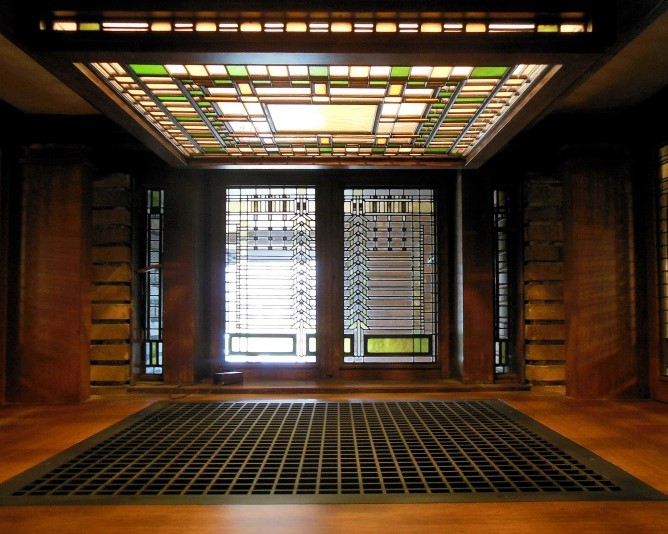
As soon as you’re at the front door of the big house, you see you what a work of art it is. Some of the stained glass windows contain hundreds of pieces of glass, the millwork is incredibly elaborate, and even the mortar joints in the masonry were lavished with care (and bronze paint). Interior photos were also frowned on in the big house, too--thank you Google images.
The Martin House Restoration Corporation has raised almost $50 million on its restoration. The house really has enjoyed an amazing rebirth, even if it’s not yet finished. Some of the rooms are unfurnished and will remain that way; others are only sparsely furnished.
The yard is a construction site
The final building on the tour was the Barton House, built by Wright for Darwin Martin’s sister, Delta Martin Barton and her husband. It’s much simpler than the Martin House, and likewise sparsely furnished.
The tour ends in the gift shop (of course) where you can buy Frank Lloyd Wright chess sets and lots of other Wright inspired tchotchkes. Visitors may take all the photos they want.
The tour had its high points and its low points. On the plus slide of the ledger, the docent didn’t make up stuff as he went along…for the most part, anyway. He did tell us that the Martins had lots of mirrors for Christian Scientists. (Huh?) The no photography rule was a downer but the hearing aids were helpful. And, in the best idea ever, the docent gave us each a comment card to complete and mail in. I’ve never, ever had that happen at the end of a tour.
After the Martin House we made tracks for Niagara Falls. We wanted to get there before The Donald created an international incident with Canada and closed the border.
We parked in the City of Niagara Falls’ enormous parking garage and paid the equally enormous $30.00 (in advance!) to park.
Niagara Falls is all about mass tourism. There were people of every age, size, shape, color, you name it, around and about. It was quite the change from the Martin House and our small group of ear hearing-aid wearing old codgers.
We walked across the Rainbow Bridge and waited in line for 20 minutes go to through passport control. The Canadian side of the falls is lovely, with a formally landscaped terrace separating the touristy falls experience from the hotels filled with honeymooners, tourists, and so on.
After some to-ing and fro-ing we finally figured out how to get in the elevator to take us the boat trip to the base of the falls. On the American side of the border, the boat is the
Maid of the Mist and passengers wear blue ponchos; in Canada it’s a Hornblower Cruise and the ponchos are red.
Shortly after we left the dock there was a short safety briefing—if we sink, there are life preservers someplace. At least I think that’s what the guy said. And shortly after that, there was a bunch of cheering at the front of the boat because…a couple had just gotten married…she in a big white dress, he in a tuxedo. I wondered if they were saving their red ponchos for the wedding night.
One thing you can say about a poncho—it doesn’t make your ass look fat, it makes all of you look fat.
The trip up the river to the falls is brief, but the falls are spectacular. In the words of Martha’s neighbor Mary, it’s a lot of water. I wasn’t tempted to make plans to return to go over the falls in a barrel.
After our boat ride, we made our way back to the Rainbow Bridge to walk back to the US of A. Interestingly enough, you have to put four quarters in a turnstile in order to leave the Canada. Paper money is not accepted, it has to be four quarters. This creates a bottleneck at the change machines. Perhaps by creating a momentary delay, Canada wants us to reconsider leaving.
Our plan after Niagara Falls was to go to Buffalo’s Pierce Arrow car museum but that was thwarted when we learned that the museum was closing early that afternoon for a private function. (I’m thinking Wingfest, if not a bar mitzvah.)
After considering a visit to the Albright-Knox Museum of Art, we opted instead for Forest Lawn Cemetery, the final resting place of many Buffalo notables. This is not to be confused with the Forest Lawn Cemetery in Los Angeles; Buffalo’s Forest Lawn came first—it was founded in 1849.
Our first stop was the visitors’ center/gift shop—you know it’s a great cemetery if it has a visitors’ center not to mention gift shop. Only the best of the best cemetery gift shops sell presidential PEZ dispensers featuring Presidents Franklin Pierce and Millard Fillmore.
After we picked up our map of the cemetery, the extremely affable Director of Tourism pointed out the final resting places of some Buffalo notables.
I don’t know how the conversation rolled around to Buffalo bigwig Grover Cleveland, but his grandson had been to Forest Lawn recently and she was kind enough to show us her photo with him. The walrus look runs in the Cleveland family.
Our first stop was to be the grave of Buffalo dentist
Alfred P. Southwick. He was the inventor of the electric chair, and I don’t mean the kind of powered chaise lounge that dentists use. He invented “Old Sparky”, the
Julius and Ethel Rosenberg kind of electric chair. Near Dr. Southwick’s final resting spot was that of the electric chair’s first customer, murder
William Kemmler. Although the Wiki account of the Kemmler’s execution sounds horrible, when it was over, Dr. Southwick said “We live in a higher civilization from this day.” Oy!
Unfortunately, we weren’t able to find Dr. Southwick or Mr. Kemmler. Perhaps we shouldn’t have been looking for a gravestone topped by Reddy Kilowatt.
But we did find the grave of Millard Fillmore, the 13th President. He and his family are in small plot, marked with an obelisk and surrounded by a low iron fence. The American flag flies overhead.
I was quite surprised to find another mourner…ok, visitor, at President Fillmore’s grave. I mean, Millard Fillmore? Seriously?
Our fellow pilgrim was a handsome and genial Ohio State grad, now a lawyer, and in town with his girlfriend/wife/whatever for a baptism. She remained in their car. He never referred to her as anything other than “she” or “her”. He noted that “she wasn’t into this kind of stuff”.
I chuckled.
In the meantime, my mind raced to months hence, after he had decided he wasn't into
that kind of stuff and had gone on to date someone older, who likes long walks on the beach, Frank Sinatra, bourbon, black coffee, and so on. Not that I know anyone who fits that description.
“How did you guys meet? Do you work together?”
“Actually, we met at Millard Fillmore’s grave.”
But I digress.
We had a great time talking about which historic sites we’d been to and which were still on our lists. He said he was going to
The Judge Advocate General's School (aka The JAG School) shortly. We yammered about Charlottesville for a bit and I was reminded for the umpteenth time that there was something about a man in uniform.
Before Mr. Future Military Lawyer went back to “her”, he told me about a great app called History Here, a product of the History Channel, that identifies nearby historic sites using GPS technology. He used it to find the Fillmore grave. I told him that I’d be downloading it pronto. He promised to read my blog.
After that interlude we went on to find Rick James, Darwin D. Martin, and the Blocher Mausoleum, which is about the choicest thing ever.
You can read more about it
here, but the reader’s digest version is that it looks as if its architect (and/or client) smoked WAY too much opium or dabbled in psychedelics. It’s a granite and glass version of that clear plastic canister people use at the drive-in bank, standing on end.
Inside the canister, blindingly white carrara marble life-sized renditions of Mr. and Mrs. Blocher mourn the early death of their son James as an angel descends to lay a wreath upon James’ noggin.
James, another Buffalonian with one helluva mustache, is on a sofa—recumbent, as art historians would say—holding a Bible, and fully dressed right down to what look like Frye boots. It’s appropriate that his footwear is so prominent in the sculpture because his father, a shoe manufacturer, is one of the people credited with popularizing the idea of right and left shoes. The mausoleum is surrounded by a matching benches and planters. It’s one of the weirdest funeral monuments I’ve ever seen.
That evening, in lieu of wings, we ate at an Asian place near the hotel. We stopped at a coffee shop-ish sort of place for coffee and dessert. The flirty barista asked if we were tourists. I showed him my photo of the photo of Grover Cleveland’s grandson. Yeah, I'm good at dating.
On Sunday morning we fired up History Here on my phone and used it to find the actual spot where President McKinley was shot by anarchist
Leon Czolgosz at Buffalo’s
Pan American Exposition in 1901. The McKinley Death Rock, as Google calls it, in its best Joe Friday just the facts tone, is a small monument placed in the grass strip that divides the lanes of a middle-class residential street. McKinley High School is at the end of the block. My guess is that as Death Rocks go, it’s one of the best.
Nothing makes you peckish like a Death Rock, so we stopped at Bertha’s Diner for a bite to eat. Not only was the food tasty—Damn! I didn’t order wings—but the service was excellent.
All fueled up, we drove to
Silo City, which self-identifies as “your average, everyday historic grain elevator complex that doubles as a music venue, theater backdrop, poetry site, and industrial film location”. You can this about Buffalo-nians, they do not hide their abandoned grain elevators under a bushel basket.
Silo City is industrial decay at its finest. I’m not sure how many silos there are—thirty-something at least—and the last one was used in the 1980s. They’ve had plenty of time to rot and fester. Trust me, they show their age.
Instead of holding mass quantities of wheat, corn, and malted barley, the site is now used for the occasional concert, art installation, and prom.
The site has its on-site hipster bar/restaurant (thankfully closed on Sunday mornings) not to mention a caretaker/hermit/homesteader in residence. He lives in a ramshackle place that seems too skanky for human habitation.
The nice folks at
Explore Buffalo offer tours of the place so that you can learn all about Buffalo’s days as a key cog in the agricultural industrial complex. You have a choice of the grounded tour or the vertical tour. The grounded folks go into the ground floor work areas of a flour mill, two grain elevators, and a malthouse.
The vertical types experience the whole shebang. There’s no elevator at the grain elevators so it’s a ten story climb up stairs, some of which are via an open spiral staircase.
The trip down is easier, though it does include a short trip down a ladder.
Back in the day, guys went from floor to floor on the manlift, which was essentially a conveyor belt that had handholds and footrests.
Count me out.
Our tour guide was the second coming of county agent Hank Kimball from
Green Acres, but as a retired teacher he was good at keeping our interest and answering questions. His sidekick wasn’t quite so voluble but her job was to act as sort of a sheepdog and round up the stragglers on the tour.
You don’t want to be lost and alone in an abandoned grain elevator.
The other folks on our tour included a Sinead O’Connor look-alike from Nova Scotia, three Buffalo locals, including one who was wearing Buffalo Bills branded shoes.
There were two twentysomethings in town for the Association of Preservation Technology conference, one of whom carried (and photographed) a
Jane Jacobs doll with her. I asked her if she would be throwing a
Robert Moses doll off the tenth floor and she replied that she liked to keep things positive.
After two and a half hours we had a pretty good idea of where the grain came in and where it went out and why it doesn’t do either of those things any longer.
And after two days we had a pretty good idea about Buffalo.
It's a cool place. You should go.
And perhaps order some wings. I hear they’re pretty good.